
Author :
Diana Sharma, Mission Director, Mission Ready
When a big industry report lands, I skip the executive summary and go looking for the numbers nobody puts on the cover. That is usually where the real story is hiding.
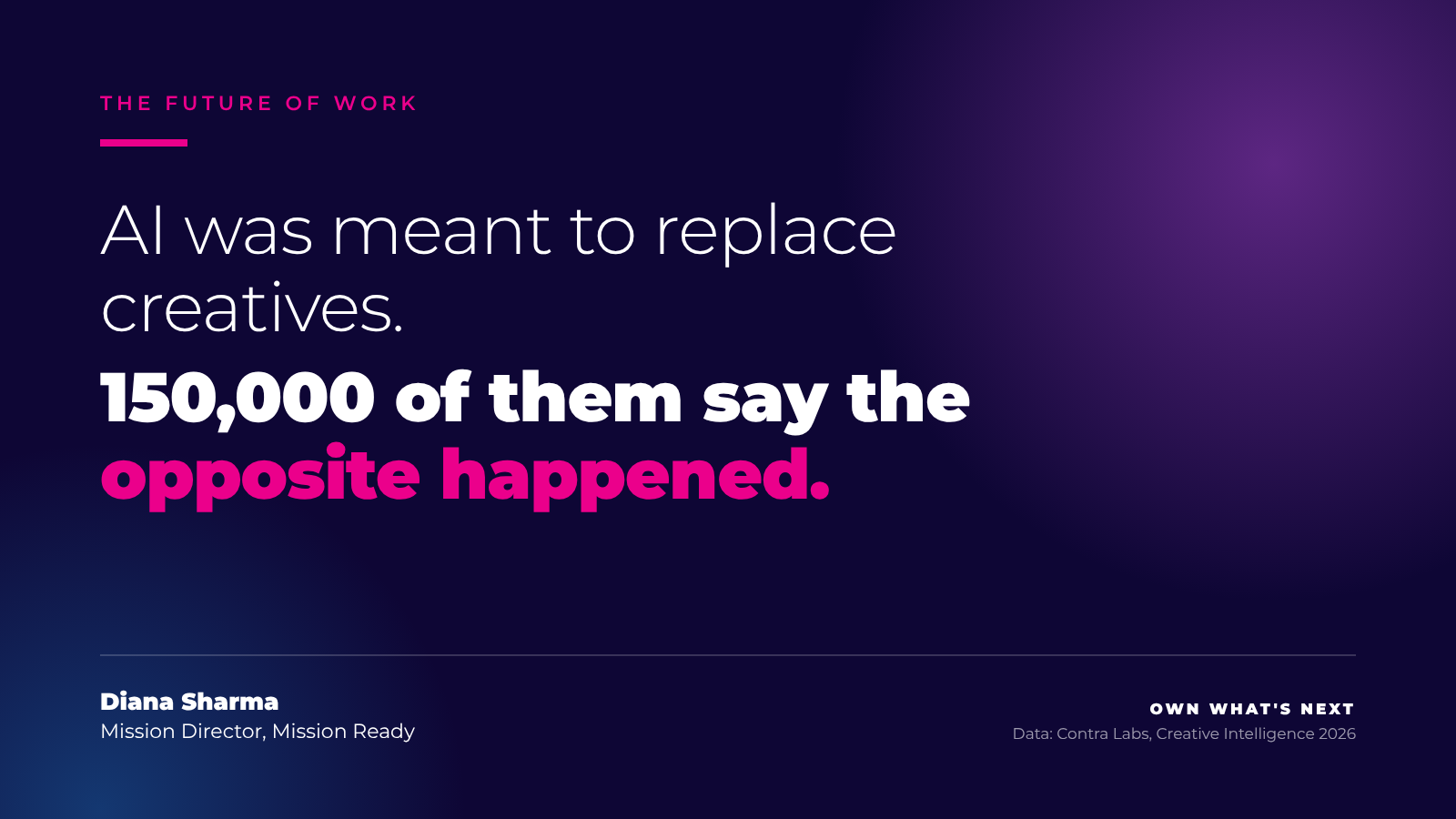
Contra Labs has just released Creative Intelligence 2026, drawing on a survey of more than 150,000 working creative professionals and data from their freelance marketplace. Their headline is bold: "Three years ago, the story was that AI would replace creatives. That's not what's happening."
Good. But I want to push on something underneath it. If the prediction was wrong, how many of the other rules we have been told about careers are wrong too?
The finding I keep coming back to is how evenly AI use is spread across experience levels. According to the report, 71.1% of junior creatives use AI, compared with 70.7% at mid level and 69.8% at senior level.
In other words, the person in their first role is using these tools at the same rate as the person with fifteen years behind them. Slightly higher, in fact.
For most of the history of work, experience has been a moat. You waited your turn, learned the tools the seniors already knew, and eventually caught up. That is not what is happening here. On this skill, everyone is starting from the same line at the same time.
So why would anyone new to the industry wait to be invited in? The door is open, and nobody is further through it than you.
The report asked creatives what slows down their adoption of AI. The answers are revealing.
Cost came out on top, named by 70.1% of respondents. Next were quality of output (44.6%), privacy and security (43.5%) and copyright (31.3%). Fear of being replaced was named by just 19.6%, under one in five.
And the learning curve? Only 6.2%. It came last on the list.
The barriers are mostly practical and commercial. Subscriptions add up. Output is not always good enough. Clients worry about where their data goes. Those are real concerns and worth taking seriously. But none of them say "this is too hard for me".
If it is not too hard, and it is not taking the job, what is stopping you starting? Use the free tiers. Pick one task you do every week. Start small enough that cost and risk are not even part of the conversation yet.
The report found that project sizes for AI-powered creatives grew by more than 40%. It also argues that taste, perspective, judgement and direction "became more valuable".
The fear was that AI would shrink the job down to pushing buttons. What these creatives describe is the opposite. The tool takes on more of the making, and the human takes on more of the deciding.
One respondent put it plainly: the work "still requires a lot of human review, taste, and context." That is not a limitation of AI. That is a job description.
This is the part of the report I find most exciting. It asked creatives which new, AI-native services they are already offering or planning to offer.
Top of the list was AI workflow design, at 60%. Half named AI creative direction, and almost as many (49.8%) named AI landing page generation. Around a third named brand image systems (36.6%), creative evaluation and AI quality assurance (32.7%) and brand prompt kits (31.8%).
Three years ago, nobody had "AI workflow design" on a CV. Now six in ten of these creatives are offering it or planning to.
Think about what these services actually need. Workflow design is process thinking. Creative evaluation and QA is critical judgement. Creative direction is leadership. None of these were invented last Tuesday. Hospitality managers, teachers, analysts and project leads have been building them for years, and now they point at a new set of tools.
Employers have noticed. Mentions of Claude in Contra marketplace job specs grew 32 times between the first half of 2025 and the first half of 2026. Nobody is asking whether you have heard of these tools any more. They are writing them into the brief.
I read reports with both eyes open. Contra is a marketplace for creative freelancers and describes itself as an evaluation layer for creative AI, so it has a stake in this story. The survey covers creative professionals, not the whole workforce, and the published page does not give full detail on sampling, geography or the earnings comparison. Treat the numbers as a strong signal, not gospel.
There are real tensions in the data too. A quarter of respondents worry AI will push their rates down. Others worry about losing their own craft by leaning on it too much. One noted that clients "often want it to not look like AI was used."
None of that is a reason to stay out. It is a reason to get in thoughtfully, so you are the one setting the standard rather than reacting to it.
Treat the level playing field as a head start. Juniors are adopting at the same rate as seniors. Show what you can do with these tools on a real project and you compete on output, not years of service.
Build a portfolio that shows judgement, not just output. Anyone can generate a draft. Show the brief, the five versions you rejected and why you shipped the one you did. That reasoning is what employers are paying for.
Learn a workflow, not a tool. The popular tools will change. The ability to break a job into steps, decide where AI helps and check the result will not.
Your experience is the "taste" the report keeps talking about. You already know what good looks like in your field. That is the scarce part now. Pair it with the tools and you are not being replaced. You are being promoted into direction.
Pilot one new service. Workflow design, AI QA, prompt kits for your team. Be the person who designed how it works in your organisation, rather than the person who was handed it.
Protect your craft on purpose. Keep doing some work by hand. Know what the tool is doing and why. The professionals who stay valuable will be the ones who can tell when the output is wrong.
I have spent years watching people talk themselves out of something before they have tried it. Too junior. Too senior. Too late. Too early.
This report quietly dismantles most of those reasons. Juniors are keeping pace. The learning curve is not the barrier. The work is getting bigger, and whole new categories of jobs are forming in front of us.
So the question is not whether you should learn this. It is what exactly you are waiting for.
If you want to build these skills on real projects, with real industry partners and people who will tell you honestly where you stand, talk to one of our Mission Advisors.
Own what's next.