
Author :
Diana Sharma
And why we think the one-person venture is the most interesting thing happening in tech right now
There's a conversation Alan and I have had at least fifty times over the past year. It usually starts the same way. Someone tells us about an idea they've been carrying around for months, sometimes years. They're genuinely good ideas. They've thought hard about them. And then comes the line that ends it:
"I just need to find a technical co-founder."
That sentence used to make sense. For a long time it was simply true. If you couldn't build software and you wanted to start a software business, you needed someone who could, and you needed to convince them to work for equity while you both lived on nothing.
We don't think that's true anymore. And we've built a programme around what replaced it.
Here's my favourite detail in all of this, because it tells you the shift is real rather than a LinkedIn mood.
Until 2022, the US Census Bureau assumed that any business earning above a certain revenue threshold must have employees. If a business declared itself a solo operation and then crossed that income line, the Bureau automatically reclassified it as an employer. It simply did not believe one person could earn that much alone.
By the early 2020s that assumption had broken. The Bureau noticed solo operators generating substantial revenue and pointedly not hiring, so in 2022 it raised the thresholds. The counts of high-earning one-person businesses immediately skyrocketed. They had been there the whole time. The measuring instrument was the thing that was wrong.
That's the moment I'd point to if someone asked me when the solopreneur stopped being a fallback and became a category.
Stripe's economics team published an analysis in June that we've read more times than is probably healthy.
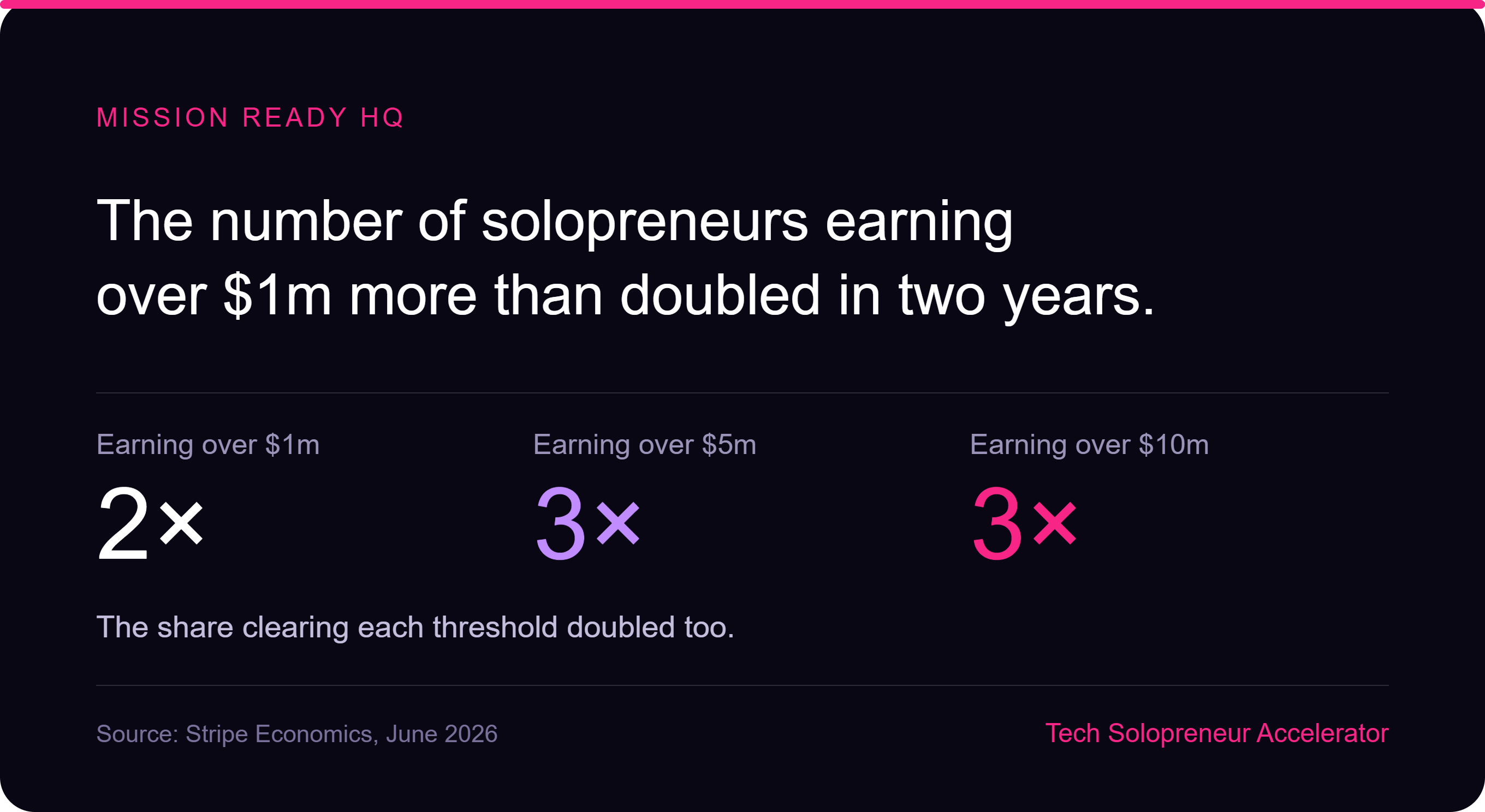
The number of solopreneurs earning over $1 million a year more than doubled between 2023 and 2025. At the $5 million and $10 million thresholds, close to three times as many crossed the line. And critically, it isn't just the raw count going up. The share of solopreneurs clearing those thresholds has also doubled in two years, which tells you this isn't a flood of hopeful experiments producing a few lucky outliers. The newer cohorts are genuinely better than the ones before them.
Underneath that, roughly four million Americans were already earning their primary income as solopreneurs generating over $100,000 a year as at 2023, up from the mid two-million range in the early 2010s.
Meanwhile, new US business applications have been accelerating since late 2024, but almost none of that lift is coming from businesses likely to hire anyone. Traditional employer-business formation has stayed flat. The entire surge is one-person ventures.
This isn't only an American story either. Since 2017, new business registrations have risen roughly 40% in Australia, 70% in Finland and 80% in France, with the sharpest acceleration in 2025 alone. In France, where the data breaks down further, it's driven overwhelmingly by solo founders rather than traditional firms.
And the identity has shifted alongside the filings. LinkedIn has recorded a 69% jump in people adding "founder" to their profile. Forty-seven percent say AI makes them more likely to start a business.
New Zealand's version of this is quieter but it's the same shape.
Stats NZ counts around 422,751 self-employed New Zealanders, about 15.2% of the workforce, and 74% of our 617,330 enterprises have no paid employees at all. The Self Employment Report from Hnry and the Simplicity Research Hub, released in July, found that self-employed Kiwis now generate 17% of GDP, roughly $78 billion a year, and that the sector is growing faster than the economy overall.
Faster than the economy overall. That's the line I keep coming back to.
Stripe's team put their finger on something that I think is the whole argument, so I'll paraphrase it closely.
The reason businesses were historically built by groups is that one person rarely holds all the skills the job requires. Sizing a market. Writing the code. Pricing the product. Running a campaign. Closing the deal. When you couldn't do one of those, you found a human who could, and that human needed paying or needed equity.
AI now fills a meaningful number of those gaps. Not all of them, and not perfectly. But enough of them that the threshold at which you're forced to bring someone on keeps climbing. Sam Altman's phrasing for this era was "revenge of the idea guys", which is glib but not wrong.
This is where our programme actually comes from, so bear with me.
AI builders have genuinely dissolved the first barrier. Around 63% of people using vibe coding tools have no developer background. J.P. Morgan documented a case where a $500,000 development agency quote became a $1,000 vibe-coded prototype for early validation. That is an extraordinary change and we're not here to talk anyone out of it. We use those tools ourselves.
But a prototype is not a product, and the failure pattern is dull in its predictability. Someone builds something impressive over a weekend. It demos beautifully. Then real users show up and it falls over. One case in 2026 saw a platform collapse under fifty concurrent users because error handling had never been engineered and database locking had never been considered. The AI had optimised for the happy path, and the happy path was the only thing that worked.
Founders who get through that stage generally do one of three things. Find a technical co-founder after all. Pay for a rebuild. Or keep the scope so small it never has to carry weight.
We think there's a fourth option and nobody is really offering it. You learn enough to own it yourself.
Not enough to become a software engineer. Enough to read what the AI wrote, judge whether it's any good, fix it when it isn't, and make architectural decisions on purpose rather than by accident.
That's the whole programme in one sentence.
Forty-one percent of founders running companies less than two years old say they plan to hire in the next quarter.
I like that statistic because it punctures the ideology. Solo isn't a religion. It's a starting position, and increasingly a viable one. Some of these ventures will stay one person forever by choice. Others will hire the moment it makes sense. The point isn't never having a team. The point is that you no longer need one before you're allowed to start.
We've deliberately built it so four quite different people can sit in the same cohort and each get what they came for.
The entrepreneur with an idea and no way to build it. You've been waiting for a technical co-founder, or getting quotes you can't justify. Ten weeks from now you'll have a tested product you built and understand, and the judgement to decide what comes next without asking anyone's permission.
The side hustler building around a job. Software is one of the few side hustles that isn't trading hours for dollars. The programme is self-directed by design, with an on-demand library open from day one, so it fits around shift work, school pickup and a full-time role. Your weekly mentor session is the rhythm, not a timetable you fall behind on.
The vibe coder who's hit the ceiling. You've built something in Lovable or Replit or Bolt. It half works. You can't fix it when it breaks and you can't explain it to anyone technical. This is the step after the AI builder, not an alternative to it. Same tools, plus the architecture underneath them and a working developer who reviews your code properly.
The intrapreneur inside an organisation. Not everyone wants to leave their job. Some of the best ventures start as a solution to a problem you see every day at work. Being the person who can prototype the thing, cost it honestly and speak credibly to the engineering team is a rare position to hold. Gartner expects citizen developers to outnumber professional engineers four to one by 2028. Being a good one rather than a dangerous one is about to matter a great deal.
The three-mentor model, most of all. Go back to that Stripe insight: one person rarely holds all the skills. AI closes some of that gap and human beings close the rest. So you get ten one-to-one sessions rotating across a technologist, a product specialist and a business operator, because a solopreneur has to be all three and nobody is born good at all three.
We're excited that the assessment is a pitch, not an exam. You present your venture, demo what you built, and explain the decisions you made and why. It's assessed against NZQA Level 6 criteria by a Category 1 provider, so the credential is real. But the thing you walk out with that matters most is the product.
We're excited about being a Foundation Partner of Auckland Startup Week, and about the session Alan and I are running on 14 October. We'll be announcing something there we're keeping quiet about for now. If you're thinking of applying, come along.
And I'm excited, and slightly terrified, that I'm enrolling in the founding cohort myself. Paying my own way, same as everyone else. I'm the non-technical co-founder of an education company that teaches people to build software and I've never built any. That seems like precisely the person who should be testing whether this works. I'll be posting weekly, including the weeks it goes badly.
Ten weeks. Starts 19 October. Auckland and online. Places are limited, it's the first cohort, and both the pricing and the attention you'll get from us reflect that.
If you've been waiting for a technical co-founder, consider this your permission to stop waiting.
Own what's next.
Ngā mihi,
Diana
Sources: Stripe Economics, The Age of the Solopreneur (June 2026); The Peak, Solopreneur businesses are on the rise (July 2026); Entrepreneur, Solopreneurship Is Set to Hit a Record High in 2026 (January 2026); US Census Bureau Nonemployer Statistics and Business Formation Statistics; Stats NZ Household Labour Force Survey; Hnry and Simplicity Research Hub Self Employment Report (July 2026); Gartner citizen developer projections.
Applications are open now: New Zealand: https://www.missionreadyhq.com/become/tech-solopreneur and Australia: at learn.missionready.academy/technical-solopreneur