
Author :
Diana Sharma
I didn't write this to relitigate the politics of fees-free. Reasonable people can debate whether this specific mechanism was the right tool.
I wrote this because I stand in front of young people every day who are trying to figure out what their future looks like in a world that is changing at speed. And I think we owe them more than a budget line that says: you're on your own.
Learning is not a luxury. In the world we're now living in, it is the single most important investment any person and any government can make.
Our young people deserve to know that we haven't given up on that.
The Budget 2026 confirmed final-year fees-free is gone. Students who started their final year before January 2025 were already locked out. Those who don't complete by the end of 2026 will miss out entirely. And from 2027, the support disappears for everyone ... no matter how far along they are, or how much they were counting on it.
For those students, this isn't an abstract policy debate. It's thousands of dollars of additional debt, with no warning and no runway to adjust.
The government's saving? Over $1 billion.. roughly $300 million a year. Tertiary providers have also been signalled they can increase tuition fees by up to 6 percent in 2027. So students will pay more, with less support.
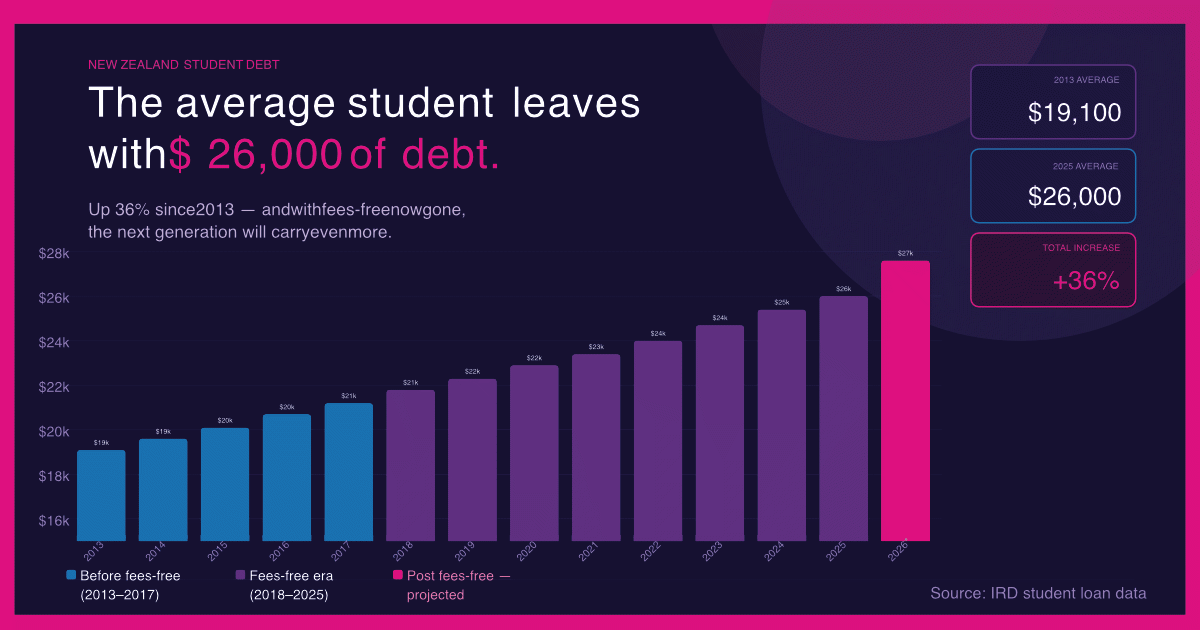
The average student loan balance in New Zealand now sits at around $26,000, up 36 percent since 2013. Young people are already leaving study carrying significant financial weight into their early careers. This decision adds to that load. And we know from the data that debt is already making families think twice: participation in tertiary education has been falling, not rising, for years.
What's happened here isn't just a policy change. It's a broken promise at a moment when the stakes for our young people couldn't be higher.
We are living through one of the most transformative periods in modern history. The future of work is not on the horizon. It is happening right now, faster than any policy cycle can keep up with.
AI is reshaping entire industries. Roles are being redefined. New ones are emerging that didn't exist three years ago. Young people are entering the workforce in the middle of all of it without the certainty their parents had, without a clear map, and without the luxury of time to figure it out slowly.
What this era requires is learning velocity... the ability to acquire new skills quickly, apply them, and adapt when the ground shifts again. That is not a personality trait. It is a muscle built through education. And it is exactly the muscle we should be helping young people develop, not pricing them out of building.
The data makes the stakes clear. Youth unemployment hit 14.4 percent in 2025. In regions like Ōpōtiki, Kawerau, and parts of the West Coast, NEET rates have nearly doubled in a single year. Entry-level roles and graduate internships are shrinking. The on-ramp into work has never been narrower.
This is not an argument for giving away money for free. It is an argument for equity of access. For a young person from a well-resourced family, debt is a manageable risk. For a first-generation learner or a family already stretched, that same debt is the reason they don't start at all. Financial barriers don't just slow people down. They stop them completely and they stop the people who have the most to gain, and the least margin for error.
The Government's justification for scrapping fees-free is that it didn't shift participation rates for the most disadvantaged learners in traditional three-year degrees. That evidence is reasonable. But the answer to "this support wasn't reaching the right people" cannot be "remove the support entirely." It should be "fund the pathways that do reach them."
Fast-track micro-credential programmes — short, stackable, employer-aligned, and completable in months — are precisely those pathways. They are not the three-year degrees disadvantaged learners couldn't finish. They are the alternative. And they just lost their funding bridge.
The young person already in study has been left behind. The 19-year-old midway through their Diploma. The 23-year-old who left a dead-end job to retrain. The first-generation learner who finally enrolled because fees-free made it feel possible. The support they were counting on has simply been removed.
If we are serious about rebuilding the pathway from learning to employment, we need to think beyond tuition support alone.
First, grow funding for programmes designed to deliver on outcomes. Short, employment-focused programmes that meet the needs of this era and subsidise access for those who need it most. The measure of success should not be enrolments. It should be pathways to employment, self employment and new venture creation.
Second, incentivise the private sector to bridge the gap. Subsidies and tax credits for businesses that take on early-career interns and graduates from domestic tertiary pathways would create real on-ramps into work at a time when entry-level roles are shrinking and young people are struggling to get their first break. This is not a radical idea. It is how many countries with strong talent pipelines operate. New Zealand should too.
Third, Government departments need to walk the talk. If we are serious about developing local, diverse, domestic talent, then our public sector needs to reflect that. Hiring decisions should prioritise early-career New Zealanders. The answer to a skills gap is not to default to expensive overseas expertise. It is to invest in growing that expertise here and bullding a pipleine model that we trust.
If we do not fund modern, equitable training models now, we will miss the economic wave and leave our most vulnerable communities behind.
Final-year fees-free meant a young person could graduate debt-free with real skills, a recognised qualification, and a genuine pathway into work. Mission Ready was built for exactly this. Because when we looked at the data, the number of young New Zealanders choosing tech as a career was declining and we knew we had to do something about this. The barrier wasn't ambition. It was access.
Artificial intelligence is no longer a future-of-work talking point. It is today’s workplace reality. In New Zealand, 91 percent of workers are already using generative AI to some degree. AI capability is linked to salary uplifts of 30 to 40 percent in the local labour market. The gap between those who can navigate this landscape and those who cannot is widening fast.
Mission Ready’s programmes are built specifically for this reality. Fast-track tech career accelerators. Micro-credentials that are stackable toward a full Diploma; designed to produce hire-ready software developers, UX designers, and data analysts in months, not years. Not a consolation prize compared to a three-year degree. For many roles in this era, a better fit. Faster. More current. Built for the moment we are actually in.
The economic case is straightforward. New Zealand has a well-documented technology skills shortage. Employer demand for AI-capable workers is outpacing supply. Fast-tracking young people particularly those from underrepresented backgrounds into tech careers is not just a social good. It is a direct contribution to New Zealand’s productivity and economic future.
Fees-free, applied to programmes like ours, was not a handout. It was a high-return investment in the people and skills this country needs most. What has been removed is not just a financial subsidy. It is a proven pipeline.
If your young person started their final year on or after 1 January 2025 and will complete by 31 December 2026, fees-free eligibility still applies. That window is open — but it is closing. Check directly with your provider or visit ird.govt.nz/fees-free for the latest, as some implementation details are still being confirmed.
If that window has passed, or your young person is considering what to do next ... do not let this news become a reason to disengage from education entirely.
The student loan scheme in New Zealand remains interest-free for those living here, with repayment tied to income. It is not a mortgage. The debt is real, but it is manageable, especially when the qualification leads to work in a field where salaries are growing.
Fast-track pathways that combine real experience still exist. The skills tech employers are hiring for right now — AI, software development, data, design — are learnable. The career is still accessible. The financial equation has changed, but the opportunity has not disappeared.
Have honest conversations. Explore every option. And know that the case for upskilling in this era is not weaker than it was before this Budget. If anything, it is stronger.
The world your young person is entering will reward those who keep learning above almost everything else. That hasn't changed.