
Author :
Diana Sharma
Something I hear a lot at the moment, in some version or another:
"It works. I just can't touch it."
Someone has built a real thing with Lovable or Replit or Bolt or Cursor. It has screens and buttons and a database. It demos beautifully. Then a bug appears, or a customer asks for one small change, and they discover they have no idea what to do next. Every fix breaks something else. The AI is confidently making it worse. And the sinking feeling arrives that the thing they own might not be an asset.
This is the vibe coding ceiling. It is real, it is predictable, and it arrives at roughly the same place for almost everyone.
I want to be clear before I go further: this is not an argument against AI build tools. We use them, we teach with them, and they have genuinely changed what a non-technical founder can do. J.P. Morgan documented a case where a $500,000 development agency quote became a $1,000 prototype. That is not a marginal improvement.
But the tools solve the first problem and not the second one, and almost nobody selling them will tell you where the boundary sits. So here it is.
It isn't one wall. It's three, and they arrive in this order.
The logic wall. The frontend usually looks fine. The trouble is underneath, where business rules end up living inside interface components instead of in a service layer where they belong. Nothing is wrong exactly, but the same rule now exists in four places and changing it means finding all four. This is why your small change keeps breaking something unrelated. The code works and the structure doesn't, and structure is the thing that determines whether you can keep going.
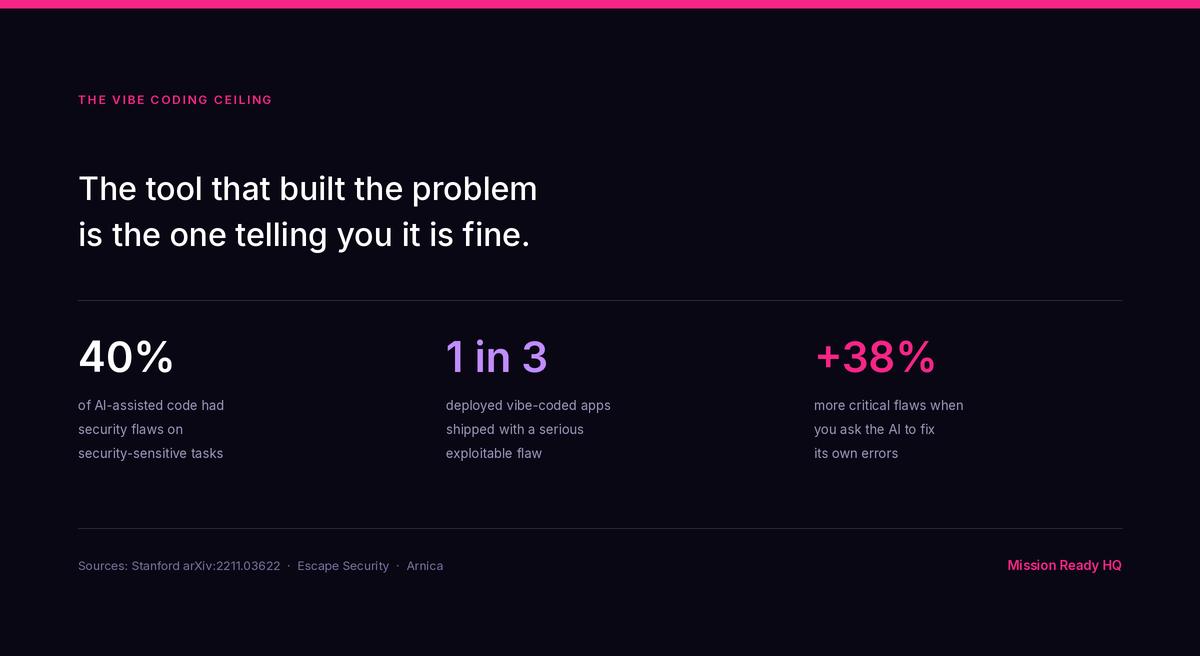
The security wall. This is the one people don't see coming, because functional testing will never surface it. Escape scanned 5,600 publicly deployed vibe-coded applications and found more than 2,000 high-impact vulnerabilities and 400 exposed secrets, meaning roughly one in three had shipped with a serious flaw someone could exploit. Veracode tested over 100 language models on security-sensitive tasks and found 45% of generated samples introduced an OWASP Top 10 vulnerability, a rate that has not improved across testing cycles from 2025 into early 2026.
The specific failure is worth understanding because it repeats. AI generates a function that checks whether a user is logged in, and it looks completely reasonable. What it doesn't check is whether that particular user owns the particular thing they just asked for. Authentication runs. Authorisation never does. Your app works perfectly for every honest user and hands the database to anyone who edits a number in a URL. In 2025 a disclosed vulnerability of exactly this type affected around 10% of the Lovable apps analysed, spanning 303 endpoints across 170 projects.
The rebuild wall. By the time the first two walls are obvious, you are choosing between hardening what you have and starting again. Neither is fast, which is precisely the opposite of what the tool promised.
Here is the finding that changed how I think about this.
A Stanford study had people complete security-sensitive coding tasks with and without an AI assistant. The group using AI produced vulnerable code around 40% of the time. They also rated their own code as more secure than the group that hadn't used AI.
Not just wrong. Confidently wrong, in the direction of comfort.
That's the ceiling in one sentence. It is not a wall you can see coming, because the tool that built the problem is also the thing telling you everything is fine.
Which is why the natural response fails. You hit a bug, you paste it back into the AI, you ask it to fix it. One analysis found that iterating with AI in this way increased critical vulnerabilities by around 38% rather than resolving existing ones. The model optimises for making the error go away, not for making the system correct. You end up in a loop, each pass adding a little more mess, and the only reason you stop is exhaustion.
Around 63% of people using these tools have no developer background. That is a lot of people who cannot evaluate what they are being handed, which is not a criticism of them. It's the whole design of the product.
Not everyone has. If your build is small, has no users, and holds no data that matters, you may be well below the ceiling and should keep going. Genuinely.
You are probably at it if:
You've stopped adding features because you're worried about breaking what's there. You cannot explain, roughly, what happens when someone logs in. You've never looked at what the AI wrote, only at whether the screen did the right thing. You have real users, or you're about to. You're storing anything you'd be embarrassed to see leaked. A fix in one place keeps breaking something in another. Or you've started saying "it works, I just can't touch it".
Three or more of those and the ceiling isn't ahead of you.
There are only four, and only one of them is us. I'd rather set them out properly.
Keep the scope small enough that it never matters. Underrated and completely legitimate. Plenty of useful software handles no sensitive data and serves a handful of people. If that's your build, the ceiling may never arrive. Be honest about whether it's actually your build.
Buy the expertise. Pay for a security and code quality audit, or bring in a developer to review and restructure. The common advice is to do this before your first paying customer rather than after, and certainly before you're holding anyone's personal data. It costs money and it works. The catch is that it's a purchase rather than a capability, so you'll be buying it again in six months.
Find the technical co-founder. Still a real option. It is also the slowest, it costs equity, and finding a good one is harder than the advice implies.
Learn enough to own it yourself. Not enough to become a software engineer. Enough to read what the AI wrote, tell whether it's any good, understand what authentication and authorisation actually do, and make architectural decisions deliberately rather than by accident.
That last one is what we built the Tech Solopreneur Accelerator for, so treat me as biased. Ten weeks, real React and Node, AI tools used properly as build partners rather than pretended away, a working developer reviewing your code every week, and an NZQA Level 6 credential at the end. It's the step after the AI builder, not an alternative to it.
The ceiling isn't a sign you did something wrong. Building the prototype was the right move, and doing it in a weekend for a thousand dollars instead of six months for half a million was obviously correct.
The mistake is only ever the same one: assuming that because the first part got easy, the second part did too. It didn't. Production software still demands the things it always demanded, and someone has to understand it.
The question is just whether that someone is you.
Ngā mihi,Diana
Sources: Escape Security scan of 5,600 deployed applications; Veracode language model security testing (2025 to 2026); Stanford University controlled study on AI coding assistants and security-sensitive tasks (arXiv:2211.03622); Georgia Tech Vibe Security Radar; CVE-2025-48757 coordinated disclosure; Hostinger vibe coding statistics 2026; J.P. Morgan founder guidance on AI-assisted prototyping.
The Tech Solopreneur Accelerator runs for ten weeks from 19 October.
Applications open:
NZ - https://www.missionreadyhq.com/become/tech-solopreneur
AU - https://learn.missionready.academy/technical-solopreneur