
Author :
PC
A winning hackathon pitch does not begin with slides.
It begins with the idea underneath them.
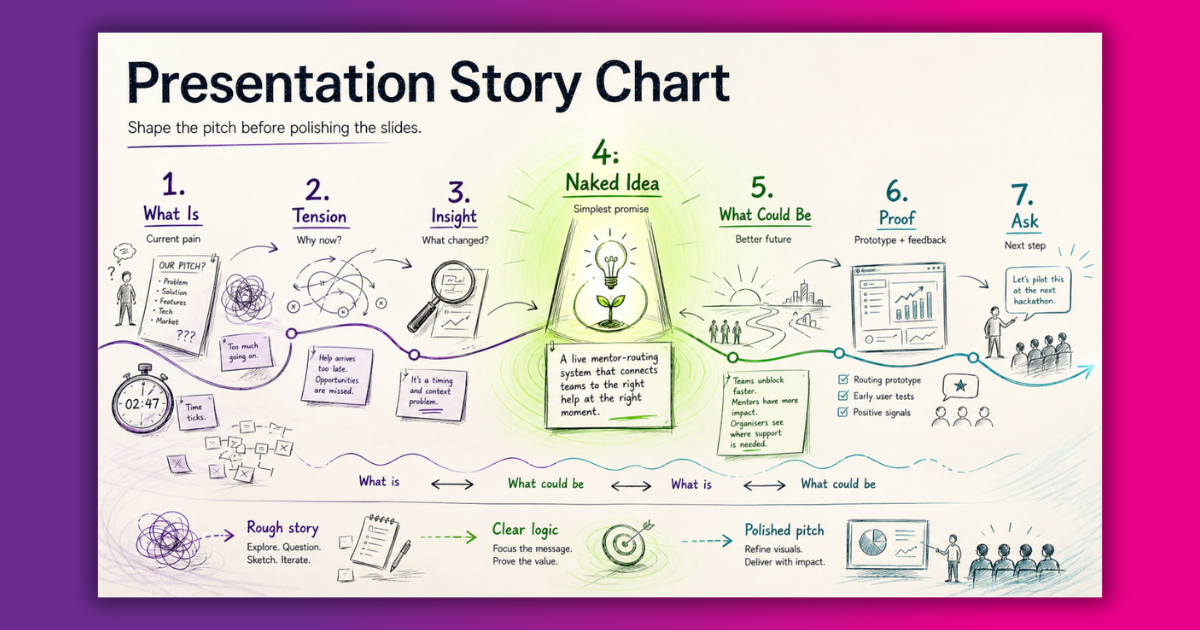
Before worrying about colours, icons, animations, or polished graphics, the team needs to find the simplest version of what they are really trying to say. Call it the naked idea: the core message with nothing decorative hiding it.
If the naked idea is weak, beautiful slides will not save it. If the naked idea is strong, even a simple diagram can be enough.
The naked idea is the pitch stripped back to its essentials:
What problem are you solving?
Why does it matter?
What have you built?
Why is your approach different?
What should the audience believe or do next?
In a hackathon, this discipline matters because time is short. It is easy to spend hours polishing a deck while the story underneath is still unclear. A better approach is to keep asking: “If we had only one minute, what would we need people to understand?”
Do not wait until the end to create the pitch.
Keep charting your story as the project evolves. As the team learns more, the story should change too. A user insight may sharpen the problem. A mentor’s question may expose a weak assumption. A failed feature may reveal a simpler, stronger direction.
The pitch is not a wrapper added at the end. It is a thinking tool throughout the hackathon.
A simple running story map can help:
Problem → Tension → Insight → Solution → Proof → Ask
Keep that visible. Keep updating it.
Nancy Duarte’s TEDx talk, “The secret structure of great talks”, is useful for hackathon teams because it shows that powerful talks often move between two states: what is, and what could be.
That is exactly what a hackathon pitch needs to do.
Show the audience the current pain. Then show them the better future your idea makes possible. Move between the two until the contrast is clear enough that your solution feels necessary.
Polished graphics are useful at the end. At the start, they can become a distraction.
A rough sketch, flow diagram, or simple before-and-after picture is often better than a beautiful but vague slide. Simple visuals force the team to clarify the logic. They reveal gaps. They make it easier for mentors and teammates to challenge the story before it becomes too expensive to change.
Use rough diagrams first. Make them clear before you make them pretty.
A good pitch does not explain everything.
It gives the audience enough to understand the idea, believe in the team, and imagine the potential. If every slide is overloaded with text, screenshots, features, and technical detail, there is no room left for the audience to think.
Show the important pieces. Let the rest breathe.
In a hackathon, judges are not only evaluating what exists. They are also evaluating what could exist if the idea had more time, support, and focus.
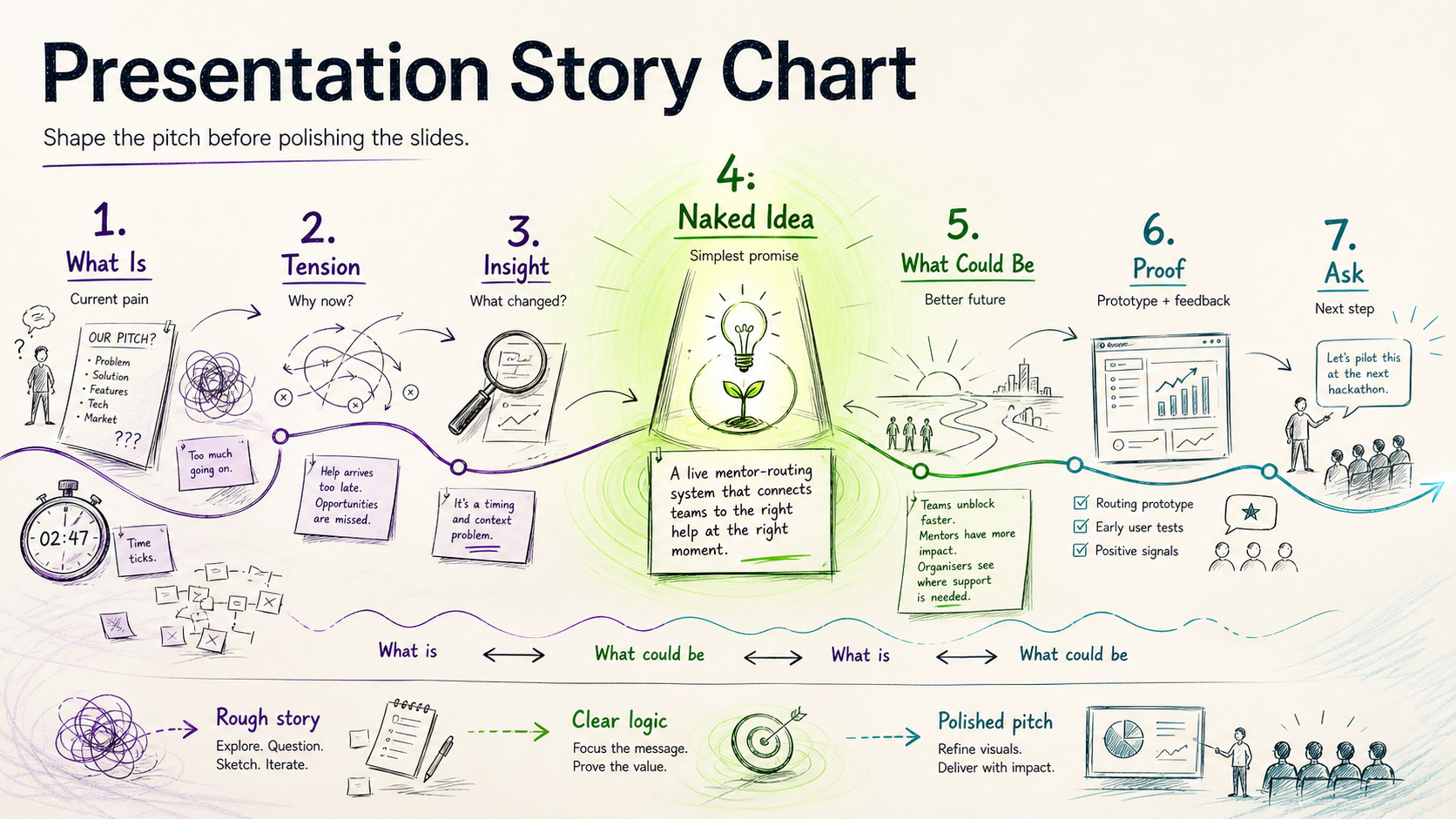
Keep the story visible while you build. Use the pitch to test whether the project still makes sense. Start with the naked idea before designing the slides.
Prefer a simple diagram over polished confusion. Use mentors to pressure-test the story, not just the product. Show the gap between what is and what could be. Leave room for the judges to imagine the bigger opportunity.
Pitching to win is not about sounding impressive.
It is about making the idea easy to understand, easy to believe, and hard to ignore.
The best hackathon pitches feel clear because the team has done the hard work underneath. They have stripped the idea back, shaped the story, tested the logic, and chosen visuals that help the audience see.
The slides are not the pitch.
The story is.