
Author :
Diana Sharma, Co-founder and Mission Director, Mission Ready
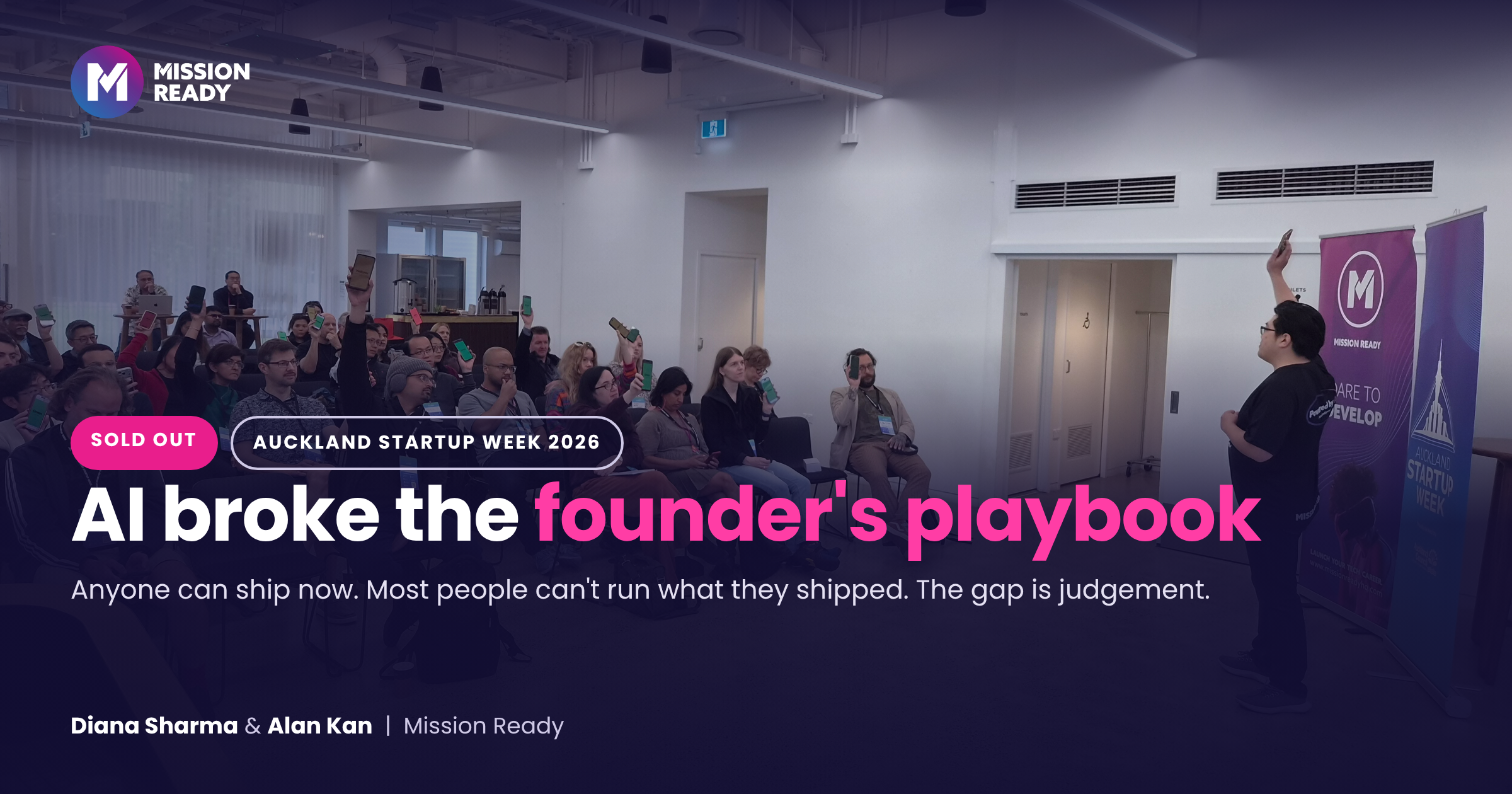
On Wednesday morning, Alan Kan and I walked into The Annex in Wynyard Quarter to a sold-out room. Two hours later, I walked out with a full notebook, a phone full of new contacts, and a feeling I haven't been able to shake since: New Zealand is full of founders with ideas we need, and the thing that has held so many of them back has just disappeared.
Thank you to everyone who came, voted, stood up, argued with us, and stayed long after we finished. Here's a summary of what we covered, for those who were there and for those who couldn't get a seat.
We opened with a provocation: your technical co-founder just became optional.
For years, the founder playbook went like this. You had the idea. You understood the market, often better than anyone, because you had lived the problem. You'd worked in hospitality, or health, or logistics, and you could see exactly what was broken.
But someone else had the ability to make it exist at all.
So your first job as a founder wasn't building. It was hunting. Coffee after coffee. Meetups. LinkedIn messages to developers you'd never met. I believe that hunt has killed more New Zealand ideas than any funding gap. We talk about capital constantly in this country. We rarely talk about the founders who never got far enough to need it.
And the hunt was always longer and harder for some people than others. If you didn't already have a developer in your network, if you were a woman, a Pasifika founder, or someone changing careers later in life, the odds were stacked against you before you'd written a single line of a business plan. Talent has always been everywhere. Opportunity has not.
What disappeared isn't the need for technical skill. What disappeared is the monopoly on shipping.
Until very recently, if you couldn't code, you couldn't ship. Now the founder who knows the problem best can put a working product in front of a real customer this week. Around 63 percent of people using AI coding tools have no developer background. That isn't developers getting faster. It's a whole new group of people building.
That changes what "early stage" even means. It used to mean an idea, a deck and a search for a team. Now it means a working product, real users, and learning what they actually do with it.
It matters even more here. 74 percent of New Zealand businesses have no paid employees. We are a nation of solo operators, and now they can build.
We ran a quick equity auction with the room. Would you give away 50 percent of your company to get version one built? Not a single hand went up. To someone you met at a meetup three weeks ago? Still nothing. And if you could build it yourself, in a month, for the cost of a few subscriptions? The room didn't even hesitate.
That silence said it all. A few years ago, that first question would have had hands in the air, because there was no other way to get version one built. Today's founders already know the deal has changed.
You no longer need to give away half your company for an MVP. Your first hire moves later, and it becomes a different person: not someone to build the thing, but someone to make it survive contact with scale.
But here's the part I wanted every founder to hear. The new bar is higher, not lower. If there's no technical co-founder, you are the one making the architecture calls. You are responsible when customer data leaks. And you need to know when the AI is wrong, because it will be. Confidently, politely, and in perfect formatting.
Then Alan took over and made it real. While the room played a live game of green, yellow or red, voting on their phones on what you can safely build solo, he built a working AI product from a single prompt.
Then he asked the question that changed the energy in the room: what might be wrong with it?
What does it cost at scale? Is the API key exposed? Can you see who is using it? Where does the data go? Are the AI's answers even real? The honest answer was that he didn't know yet, and neither did the AI. It hadn't raised a single one of those questions.
Alan walked us through where solo-built products fall over: the thousand-user wall, where everything that worked for ten users suddenly doesn't; the security holes AI tools quietly leave behind; and the laws that apply whether or not you knew they existed, from the Privacy Act to the Fair Trading Act.
His landing line is the one I keep coming back to: anyone can ship now. Most people can't run what they shipped. The gap is judgement.
If you take one thing away, take Alan's six questions. If you can't answer all of them, you're not ready for real users or real money.
What stayed with me most wasn't anything we said on stage. It was the conversations afterwards. Founders with ideas for health, education, trades, community services and so much more. People who know their industries inside out and have been waiting years for a way to build what they can already see.
These are exactly the ideas New Zealand needs. And for the first time, the people who understand these problems best can build the solutions themselves.
This is exactly why we built the Tech Solopreneur Accelerator. It's a 10-week NZQA Level 6 micro-credential that takes founders from idea to a tested product they own, with three mentors (tech, product and business) and a one-to-one session every week. It's high-code, not no-code, because building is only half the job. The other half is the judgement to run what you build.
Our founding cohort starts on Monday, and they won't be starting with an empty toolbox. A huge thank you to our partners Notion, Airwallex and Customer.io for backing our founders from day one.
And thank you to the Auckland Startup Week team for having us as a Foundation Partner, and to everyone who filled that room.
If you have an idea you've been carrying for too long, now is the time to build it. Find out more at missionreadyhq.com/become/tech-solopreneur.
Talent is everywhere. Now, so is the opportunity to build.